Göbekli Tepe: The Site That Rewrote Human History
| *Published: July 2026 | Category: Neolithic Archaeology* |
For decades, the textbook story of human civilization was simple: humans invented agriculture, settled down in villages, and only then built massive temples and cities. But in 1994, a groundbreaking discovery in southeastern Turkey completely flipped this timeline upside down.
Welcome to Göbekli Tepe, a massive megalithic complex built around 9600 BCE—more than 11,000 years ago. It is roughly 6,000 years older than Stonehenge and older than agriculture itself.
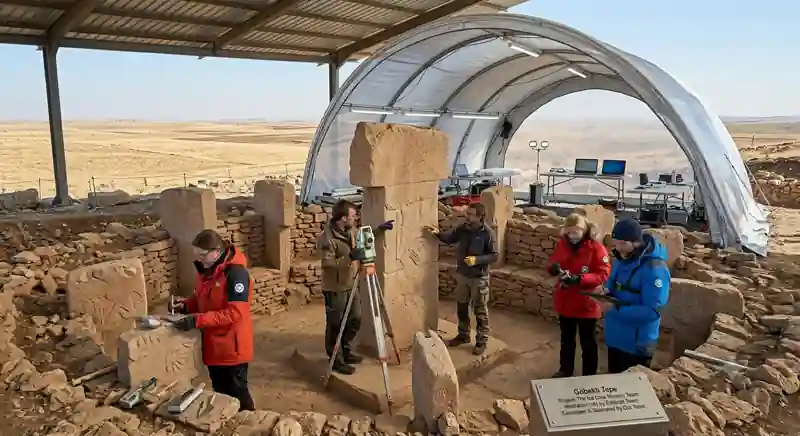
The massive T-shaped limestone pillars of Göbekli Tepe, excavated under the direction of Klaus Schmidt. Illustration created by our editorial team using AI tools for this article.
🏛️ What Makes It Unique?
The site consists of multiple stone circles featuring massive T-shaped limestone pillars, some weighing up to 20 tons. What shocks archaeologists is the artistic detail carved into the stone without the use of metal tools:
- Animal Reliefs: The pillars are decorated with intricate carvings of foxes, scorpions, lions, vultures, and snakes.
- No Signs of Domestic Life: Excavations found thousands of animal bones (mostly wild gazelles and aurochs), but no traces of houses, kitchens, or domestic water sources.
This means Göbekli Tepe was not a village or a town. It was a regional sanctuary—a cathedral in the wilderness.
🌾 Did Religion Create Agriculture?
Before this discovery, historians believed that agriculture provided the food surplus needed to build complex structures. Göbekli Tepe suggests the exact opposite.
The German archaeologist Klaus Schmidt, who led the excavations, proposed a revolutionary theory: “First came the temple, then the city.”
To feed the hundreds of hunter-gatherers required to carve and transport these 20-ton stones, people needed a reliable, massive food source. This pressure likely forced them to start domesticating wild wheat and animals nearby. In short, the desire to build a religious sanctuary may have triggered the birth of farming.
💬 Join the Discussion
Göbekli Tepe continues to challenge our understanding of the Neolithic Revolution. Do you think complex rituals existed before farming, or are we missing hidden settlements nearby?
Share your thoughts, articles, or theories in the Giscus comments section below!